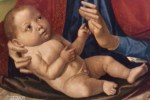
 Anyone who spends any time mooching around art galleries cannot fail to be struck by the quite remarkable ugliness of many infant Jesuses. I’m not talking about the extreme stylisation – derived from the Byzantine tradition – of Virgin and Child in late medieval paintings, but of the more realistic renderings of the Renaissance and beyond, where serene, beautiful and recognisable adult humans are adoring a distorted grotesque. It makes one wonder if any sixteenth-century Italian artist ever saw an unswaddled baby. Continue reading
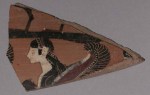 I came across this fragment in the online catalogue of the Fitzwilliam Museum while looking for something else. Ha! Corinthian, I thought, in my ignorant way, but it isn’t: it’s sixth-century BCE Clazomenian, as
 For one reason and another (one being the
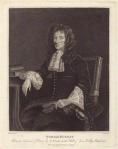 Rustat Road in Cambridge is where, in a former century, one used to go and pay one’s water rates to the Cambridge Water Company. I haven’t been able to find a picture of the building online, but I have a dim memory of an impressive brown-brick edifice with lots of dark wood in the entrance hall, to which one cycled over the Hills Road bridge and down Cherry Hinton Road, to avoid the extra cost of a stamp. The building had a lot of space around it, which couldn’t of course be allowed to happen, and by at least 2005 (probably earlier) it had been demolished, to be replaced by apartment housing and a small-business unit.
 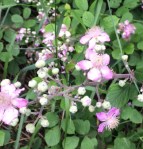 Bramble or blackberry, friend or foe? I can afford to regard the bramble as a friend because I don’t have any in my garden. Another (human) friend, who is slowly reclaiming an overgrown allotment, reports that brambles (along with nettles and convolvulus, which are less delicious) are her best crop this year. It is telling that the
 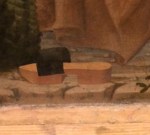 In the Eremitani Museum in Padua the other day, I was struck (as so often) by some of the details in the paintings on display as much as by the overall effect of a particular composition. Take this clog (left), for example, cast off by St Jerome when he returned to his well-appointed cave after a bit of outdoor meditation. One can almost see him wiggling his toes as he settles down to another stretch of writing.
 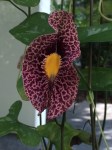 The
The  I was dining at the Reform Club the other night (not something that happens to me particularly often). I didn’t get to see
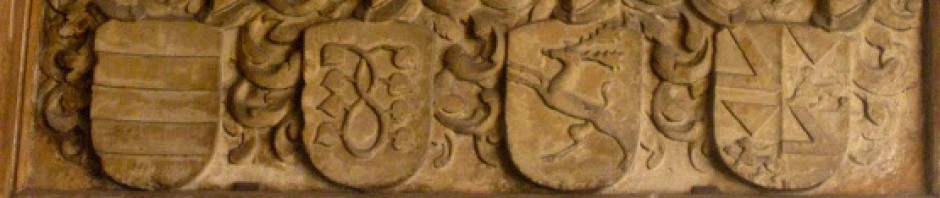
  The apotheosis of Nelson was already well under way in 1836, when one George Gunning, of Frindsbury in Kent, presented
 -
Search
Professor Hedgehog’s Archive
- November 2024 (1)
- August 2024 (1)
- June 2024 (1)
- January 2024 (1)
- October 2023 (2)
- July 2023 (2)
- June 2023 (2)
- May 2023 (1)
- February 2023 (1)
- January 2023 (2)
- October 2022 (2)
- August 2022 (2)
- July 2022 (3)
- June 2022 (1)
- May 2022 (1)
- April 2022 (3)
- March 2022 (2)
- February 2022 (2)
- January 2022 (2)
- November 2021 (2)
- October 2021 (1)
- September 2021 (2)
- August 2021 (1)
- July 2021 (2)
- May 2021 (1)
- April 2021 (1)
- March 2021 (2)
- February 2021 (2)
- January 2021 (2)
- December 2020 (1)
- November 2020 (2)
- October 2020 (2)
- September 2020 (2)
- August 2020 (2)
- July 2020 (3)
- June 2020 (2)
- May 2020 (2)
- April 2020 (3)
- March 2020 (5)
- February 2020 (6)
- January 2020 (4)
- December 2019 (1)
- November 2019 (1)
- October 2019 (5)
- September 2019 (6)
- August 2019 (2)
- July 2019 (4)
- June 2019 (3)
- May 2019 (5)
- April 2019 (3)
- March 2019 (5)
- February 2019 (3)
- January 2019 (4)
- December 2018 (3)
- November 2018 (6)
- October 2018 (3)
- September 2018 (5)
- August 2018 (4)
- July 2018 (3)
- June 2018 (3)
- May 2018 (5)
- April 2018 (6)
- March 2018 (5)
- February 2018 (4)
- January 2018 (4)
- December 2017 (2)
- November 2017 (2)
- October 2017 (3)
- September 2017 (5)
- August 2017 (2)
- July 2017 (5)
- June 2017 (4)
- May 2017 (4)
- April 2017 (6)
- March 2017 (4)
- February 2017 (4)
- January 2017 (5)
- December 2016 (3)
- November 2016 (4)
- October 2016 (4)
- September 2016 (6)
- August 2016 (5)
- July 2016 (6)
- June 2016 (5)
- May 2016 (6)
- April 2016 (8)
- March 2016 (5)
- February 2016 (7)
- January 2016 (7)
- December 2015 (7)
- November 2015 (9)
- October 2015 (9)
- September 2015 (9)
- August 2015 (9)
- July 2015 (13)
- June 2015 (12)
- May 2015 (7)
- April 2015 (6)
- March 2015 (5)
Tags
- abolition
- Apple Day
- Archaeology
- art
- autumn
- botanic gardens
- botany
- British Museum
- cabinet of curiosities
- Cambridge
- Cambridge University Botanic Garden
- Canaletto
- ceramics
- Charles Darwin
- Charles Jones
- Chelsea Physic Garden
- Christmas
- churches
- Daniel Solander
- EdUKaid
- Exploration
- Fitzwilliam Museum
- Florence
- flower painting
- flower paintings
- folklore
- gardening
- Garden Museum
- gardens
- herbals
- herbaria
- Hieronymus Bosch
- holidays
- Italy
- Japan
- John Martyn
- John Ruskin
- knitting
- Linnaeus
- Linnean Society
- London
- London churches
- Lucca
- Mill Road Winter Fair
- mosaics
- Mrs Delany
- Museum of Cambridge
- museums
- Napoleon
- natural history
- painting
- paintings
- Palermo
- plant of the month
- plants
- printing
- retirement
- Royal Society
- Sicily
- Sir Hans Sloane
- Sir J.E. Smith
- Sir Joseph Banks
- slavery
- Spitalfields
- spring
- still life
- taxonomy
- The Gentle Author
- Thomas Bewick
- Titian
- Torcello
- trees
- Venice
- Veronese
- Worcestershire
Categories
 Professor Hedgehog's Journal